

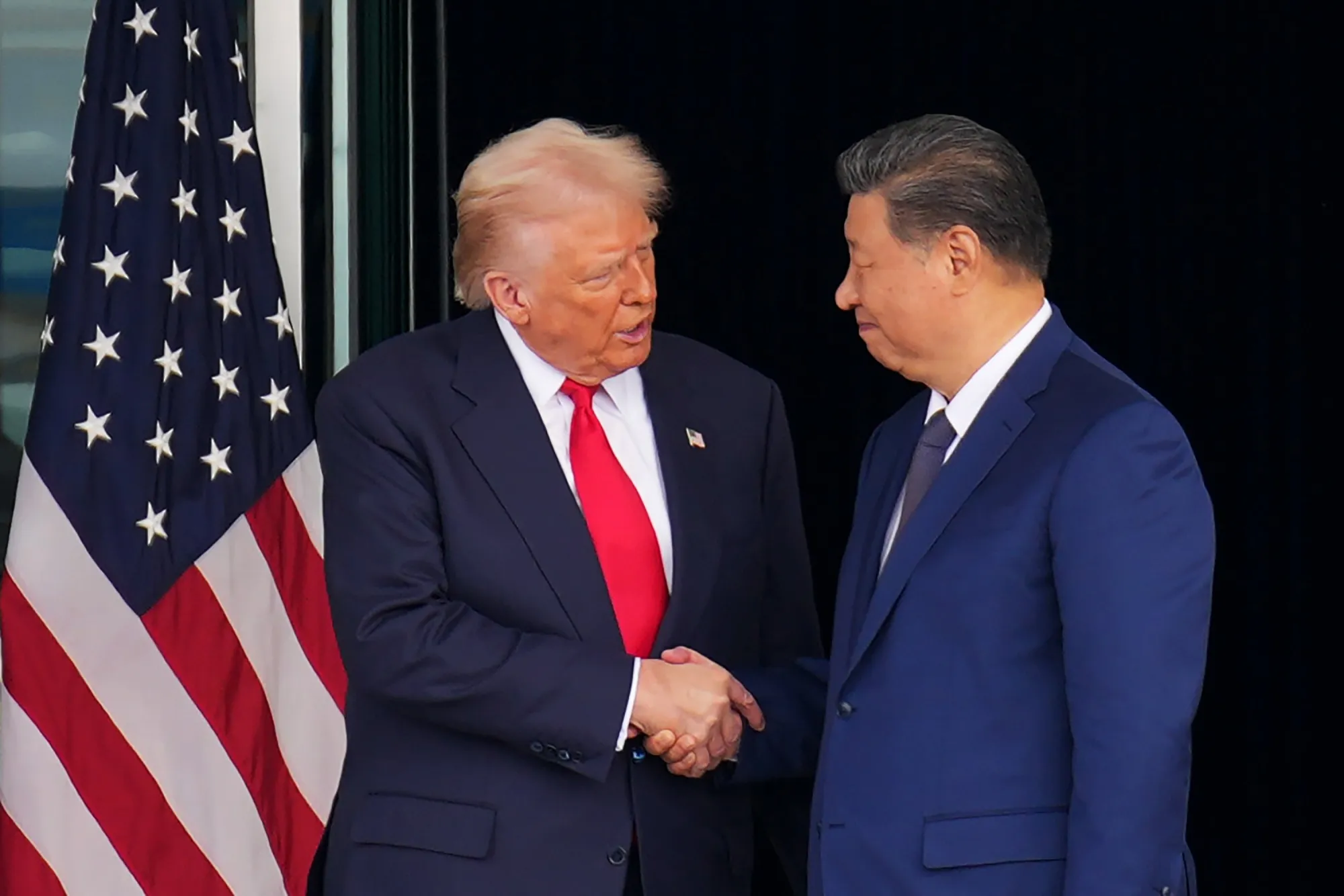
US President Donald Trump emerged from his meeting with Chinese leader Xi Jinping beaming, labeling the conversation “truly great.”
But the one-year truce struck on Thursday in South Korea is likely to only stabilize relations between the world’s two largest economies rather than resolve fundamental differences, with both sides buying time to further reduce dependence on each other in strategic areas. And it made clear just how much stronger China has become since Trump’s first term in office.
Trump’s move to cut the fentanyl tariff and extend the existing truce on reciprocal tariffs will leave many products facing a levy around 47%, low enough for China’s massive manufacturing base to remain competitive with regional rivals. Just as significantly, the US agreed to suspend a rule expanding restrictions on blacklisted Chinese firms, showing that Xi’s sweeping rare earth curbs could potentially put a cap on new US export controls — something China has sought for years.
“China gave some ground, but the clear dynamic is how Chinese threats have gotten the US to back off a series of proposed restrictions,” said Scott Kennedy, senior adviser at the Center for Strategic and International Studies in Washington. “Xi has created more safe space for China’s economic system and its efforts to achieve greater global leadership.”
Trump secured the resumption of soybean sales and rare-earths flows, addressing key political and economic vulnerabilities. The agreement to sell the US operations of ByteDance Ltd.’s TikTok provides Trump the chance to brag to younger voters he kept the popular social video app alive. And hawks in Washington will be relieved Trump didn’t allow China access to Nvidia Corp.’s flagship artificial intelligence chips or soften the US commitment to Taiwan.
Still, the agreement didn’t yield the type of structural changes that Trump has long promised to address the imbalanced US-China trading relationship. And for markets eager to escape the tit-for-tat escalations and broad uncertainty that has defined recent months, it was hard to read Thursday’s result as more than a temporary pause in a longer-term struggle for supremacy that may last for years.
“I don’t think you’re going to see decoupling — I think you’re going to see strategic decoupling,” Robert Lighthizer, Trump’s lead trade negotiator with China during his first term, told Bloomberg Television on Thursday as the summit kicked off.
“This is only going to be something that’s going to last for a period of months, or perhaps a year or so,” he added. “And then we’re going to be back there, and have to look at it again.”
Trump said as much on the way back from the meeting in Busan, South Korea, near where leaders are gathering for the Asia-Pacific Economic Cooperation summit. He mentioned he would be visiting China in April, and Xi would then head over to the US at some point after that.
“We have a deal — now, every year, we’ll renegotiate the deal,” Trump told reporters aboard Air Force One. He added that he thought it would “be very routinely extended.”
Trump seemed happy with the result, writing on social media that the agreement would be a boon to farmers, help curb the fentanyl crisis and could result in an energy deal that boosts the US economy.
“The agreements reached today will deliver Prosperity and Security to millions of Americans,” he wrote.


0 comments:
Post a Comment